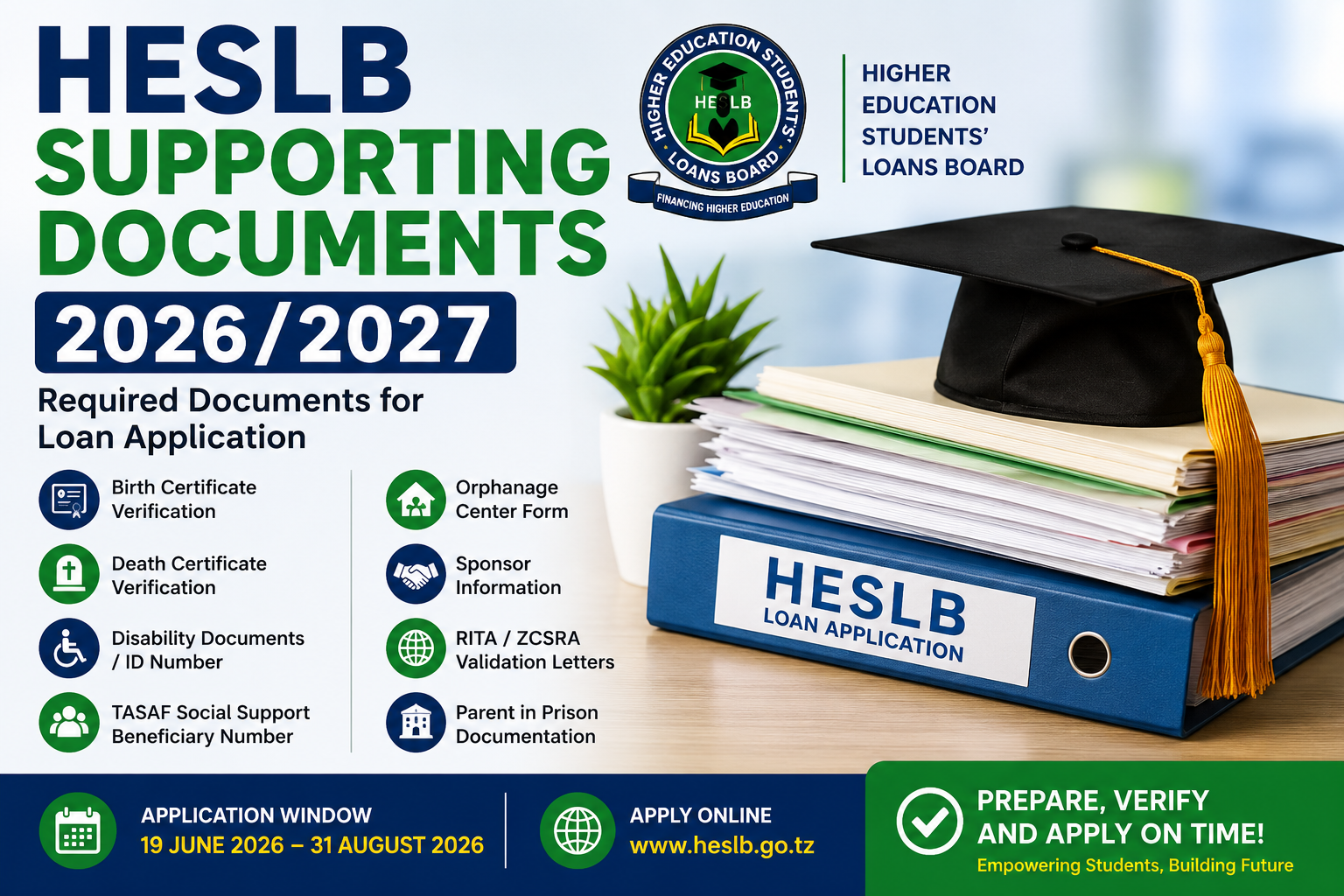
Learn about HESLB Supporting Documents 2026/2027, including birth and death certificate verification, disability documents, TASAF details, orphanage forms, sponsorship and other required documents.
HESLB Supporting Documents 2026/2027: Required Documents for Loan Application
If you are planning to apply for a higher education student loan through the Higher Education Students’ Loans Board (HESLB) for the 2026/2027 academic year, one of the most important things you need to prepare is your supporting documentation.
Submitting an application through the HESLB Online Loan Application System (OLAMS) is not simply about filling in your personal and academic information. Applicants are also expected to provide relevant information and supporting documents that can be used to verify their eligibility and special circumstances.
The official HESLB 2026/2027 guidelines identify several important documents that may support a loan application, including birth certificate verification, death certificate verification for applicants with deceased parents, disability documentation, TASAF Social Support Beneficiary information, orphanage documentation, sponsorship information and documents relating to parents who are in prison.
Kwa hiyo, kama unaandaa application yako ya HESLB, ni muhimu sana kuhakikisha documents zako ziko sahihi kabla ya ku-submit application.
Important: Requirements can vary according to the type of applicant and programme. Applicants should always read the official HESLB guidelines for the relevant category before submitting an application.
HESLB Supporting Documents 2026/2027 – Quick Overview
The following table provides a quick overview of some of the key supporting documents identified in the official 2026/2027 HESLB guidelines.
| Supporting Document | Who May Need It? | Purpose |
|---|---|---|
| Birth Certificate Verification Code | Applicants | Verification of birth information |
| Death Certificate Verification Code | Applicants with deceased parent(s) | Verification of parent’s death |
| Disability Form/Identification Number | Applicants or parents with disability | Verification of disability status |
| TASAF Social Support Beneficiary Number | Applicants from vulnerable households | Evidence of social support |
| Orphanage Center Form | Applicants raised in orphanage centres | Evidence of financial/social assistance |
| Sponsor Information | Sponsored applicants | Verification of corporate sponsorship |
| RITA/ZCSRA Letter | Applicants born abroad or with parent(s) who died abroad | Validation of relevant records |
| Prison-related Letter | Applicants with parent(s) in prison | Verification of parent’s status |
These documents are drawn from the 2026/2027 Bachelor and Diploma HESLB guidelines.
What Are HESLB Supporting Documents?
HESLB supporting documents are official records or verification details that applicants may need to provide to support information submitted in their loan applications.
They help HESLB verify information concerning an applicant’s:
- Identity and birth information
- Family circumstances
- Orphan status
- Disability status
- Vulnerability
- Sponsorship
- Parent’s circumstances
- Other special circumstances relevant to the application
The documents are particularly important where an applicant is claiming a circumstance that may affect the assessment of their loan application.
For example, an applicant whose parent has died may be required to provide a death certificate verification code verified by RITA or ZCSRA. Similarly, applicants with disabilities may need a verified disability form or, where applicable, a disability identification number.
HESLB Supporting Documents Required for 2026/2027
1. Birth Certificate Verification Code
One of the key supporting requirements mentioned in the 2026/2027 HESLB guidelines is the birth certificate verification code approved by RITA or ZCSRA.
This information is used to verify an applicant’s birth details.
Applicants should therefore make sure that their birth information is accurate and corresponds with the information they provide during the OLAMS application process.
Why Is Birth Certificate Verification Important?
Birth information is an important part of establishing an applicant’s identity and eligibility.
If your birth information has errors or inconsistencies, you should resolve the issue before completing your application where possible.
Kwa kifupi: Usikimbilie ku-submit application bila kuhakikisha taarifa za birth certificate zinaendana na taarifa utakazoweka OLAMS.
2. Death Certificate Verification Code for Deceased Parents
Applicants whose parent or parents are deceased may be required to provide a death certificate verification code verified by RITA or ZCSRA.
This is particularly important for applicants who are declaring the death of a parent as part of their family or vulnerability circumstances.
What Should Applicants Check?
Before submitting your application, make sure:
- The parent’s death information is correct.
- The death certificate information can be verified.
- The relevant verification code is available.
- Names and other details are consistent with official records.
HESLB specifically lists death certificate verification among the relevant documents supporting loan applications for 2026/2027.
3. Disability Documents
Applicants with disabilities, or applicants whose parents have disabilities, may need to provide documentation supporting the disability claim.
The 2026/2027 guidelines state that applicants may use a self or parent disability form verified by a District Medical Officer (DMO) or Regional Medical Officer (RMO).
However, applicants who have a disability identification number provided by the Prime Minister’s Office are encouraged to provide that number instead of filling in the disability form.
Disability Verification Checklist
If this applies to you, check that:
- The disability information is accurate.
- The required medical verification has been completed where applicable.
- The relevant disability identification number is available if you have one.
- The information submitted through OLAMS is consistent with the supporting documentation.
4. TASAF Social Support Beneficiary Number
Another important supporting detail mentioned by HESLB is the Social Support Beneficiary’s number from TASAF.
This can be relevant to applicants who come from vulnerable households and are beneficiaries of social support.
The number helps provide evidence of the applicant’s vulnerable household status.
Why TASAF Information Matters
If you are a TASAF beneficiary, make sure you enter the correct beneficiary information.
Do not guess the number or use another person’s information.
Important: Supporting information should always be genuine and verifiable.
5. Orphanage Center Form
Applicants who were raised in an orphanage centre may have another important supporting document to consider.
HESLB’s 2026/2027 guidelines mention the Orphanage Center Form as evidence of financial and social assistance received from childhood up to admission into a tertiary education institution.
This documentation can therefore be important for applicants whose background includes being supported by an orphanage centre.
What Does the Form Help Prove?
The form can help demonstrate:
- That the applicant was raised in an orphanage centre.
- The nature of financial support received.
- The applicant’s social background.
- The relationship between the applicant and the orphanage centre.
Applicants in this category should make sure the relevant form is properly completed and available as required by the applicable HESLB guidelines.
6. Documents for Sponsored Students
Sponsored students may also need to provide relevant sponsorship information.
According to the 2026/2027 HESLB Bachelor and Diploma guidelines, sponsored students should ensure that the corporate sponsor is registered through the HESLB Education Sponsors Portal and has uploaded the sponsor’s details into the portal.
This means students should not assume that simply having a sponsor automatically completes the HESLB verification process.
Sponsored Applicants Should Check:
- Whether the sponsor is registered.
- Whether the sponsor’s details have been uploaded.
- Whether the information matches the student’s application.
- Whether the sponsor information is current and correct.
7. Applicants Born Abroad
Applicants who were born outside Tanzania may have additional verification requirements.
The 2026/2027 HESLB guidelines indicate that applicants born abroad should obtain a letter from RITA or ZCSRA to validate their birth information. Similar validation may apply where a parent died abroad.
Therefore, applicants in this category should pay particular attention to the verification of their birth and family records.
8. Parents Who Died Abroad
If an applicant’s parent died outside Tanzania, the applicant may need a letter from RITA or ZCSRA validating the parent’s death information.
This is important because HESLB needs reliable documentation to verify information provided in the application.
Applicants should therefore avoid submitting incomplete or unverifiable information.
9. Parent Who Is in Prison
The 2026/2027 HESLB guidelines also provide for applicants whose parent is currently in prison.
The applicant may need documentation from the relevant authority to prove the parent’s current status.
For Mainland Tanzania, the guidelines mention the Ministry of Home Affairs (MoHA) or Tanzania Prisons Services. For Zanzibar, the guidelines refer to the President’s Office – Regional Administration, Local Government and Special Department of Zanzibar.
This documentation is intended to verify the circumstances declared by the applicant.
HESLB Documents Checklist 2026/2027
Before submitting your HESLB loan application, use the following checklist.
General Checklist
- Birth certificate verification information
- Death certificate verification information, if applicable
- Disability documentation, if applicable
- Disability identification number, where applicable
- TASAF Social Support Beneficiary Number, if applicable
- Orphanage Center Form, if applicable
- Sponsor information, if applicable
- RITA/ZCSRA validation letter, if born abroad
- RITA/ZCSRA validation letter, if parent died abroad
- Relevant prison-status documentation, if applicable
- Correct personal information
- Correct academic information
- Correct application details
Muhimu: Sio kila applicant anahitaji kila document kwenye list hii. Supporting documents depend on your individual circumstances and the applicable HESLB guideline.
HESLB Supporting Documents Application Flow
A simple way to understand the process is:
Prepare Documents → Verify Information → Complete OLAMS Application → Upload/Provide Required Information → Submit Application → Check Application Status
The HESLB website advises prospective applicants to read the relevant year’s Loan Application Guideline, prepare attachments such as birth certificates, academic certificates and national IDs, ensure documents are certified by relevant authorities, complete and submit applications online through OLAMS, and keep checking the HESLB website for updates.
HESLB 2026/2027 Application Timeline
HESLB officially opened the 2026/2027 loan application window on 19 June 2026. The application deadline is 31 August 2026.
Note: The chart above is a visual representation of the two officially announced application milestones, not a daily application-volume chart.
Important HESLB Application Tips for 2026/2027
1. Read the Official HESLB Guidelines
Do not rely entirely on social media posts, WhatsApp groups or information from friends.
HESLB has published separate 2026/2027 guidelines for Bachelor Degree, Diploma, Postgraduate Diploma in Legal Practice and Samia Scholarship applicants.
Read the Official HESLB Application Guidelines
2. Use Correct Information
All information submitted through OLAMS should be accurate.
Avoid:
- Fake documents
- Incorrect names
- Incorrect dates of birth
- False family information
- Someone else’s identification details
- Incorrect TASAF information
- Unverified claims
Providing inaccurate information can create problems during verification.
3. Make Sure Documents Are Verifiable
HESLB’s applicant obligations specifically emphasize preparing attachments and ensuring documents are certified by relevant authorities.
This is especially important for documents involving:
- Birth
- Death
- Disability
- Sponsorship
- Vulnerability
- Orphanage support
- Parents abroad
- Parents in prison
HESLB OLAMS and Supporting Documents
The Online Loan Application System (OLAMS) is the system used by HESLB for online loan applications.
Applicants should carefully follow the instructions provided by HESLB for the respective academic year.
The official HESLB website currently provides access to the application guidelines and online application resources.
Visit the Official HESLB Website
Tip: Always access OLAMS through official HESLB channels rather than suspicious links shared on social media.
Common Mistakes Applicants Make
1. Waiting Until the Last Day
One of the biggest mistakes is waiting until the deadline before preparing supporting documents.
Since the 2026/2027 application deadline is 31 August 2026, applicants should start preparing early.
2. Using Unverified Documents
Do not assume that any document will automatically be accepted.
Where HESLB specifies verification by RITA, ZCSRA, DMO, RMO or another relevant authority, follow the applicable requirement.
3. Entering Wrong Information
Small differences in names, dates or identification information can cause unnecessary verification problems.
4. Ignoring the Official Guidelines
The HESLB guidelines are the primary source for understanding the requirements for the relevant applicant category.
Difference Between Supporting Documents and General Application Information
It is useful to understand that not every piece of information entered into OLAMS is necessarily a supporting document.
For example, an applicant may provide personal, academic, admission and contact information as part of the application.
Supporting documents, on the other hand, are records or verification information used to support particular claims or circumstances.
For example:
Personal Information → Application Details
Birth Certificate → Birth Verification
Death Certificate → Parent’s Death Verification
Disability Form → Disability Verification
TASAF Number → Vulnerability Verification
This distinction helps applicants understand why some documents are required only in specific circumstances.
Frequently Asked Questions (FAQ)
- What are HESLB Supporting Documents 2026/2027?
HESLB Supporting Documents 2026/2027 are documents and verification information used to support information provided by applicants during the HESLB loan application process.
- What documents are required for HESLB 2026/2027?
Depending on your circumstances, supporting documentation may include birth certificate verification, death certificate verification, disability documentation, TASAF beneficiary information, an Orphanage Center Form, sponsorship information, RITA/ZCSRA validation letters and documentation relating to parents in prison.
- Do all HESLB applicants need all supporting documents?
No. Not every applicant will need every document. Some documents apply only to specific circumstances such as having a deceased parent, disability, TASAF vulnerability status, sponsorship, being born abroad or having a parent in prison.
- Is a birth certificate required for HESLB?
Birth information is an important part of the HESLB application, and the 2026/2027 guidelines identify a birth certificate verification code approved by RITA or ZCSRA among relevant supporting documents.
- What if my parent is deceased?
Applicants with deceased parent(s) should provide the relevant death certificate verification code verified by RITA or ZCSRA, according to the applicable 2026/2027 guidelines.
- What if I have a disability?
The guidelines provide for a self or parent disability form verified by a DMO or RMO. Applicants who have a disability identification number from the Prime Minister’s Office are encouraged to provide that number instead of filling in the disability form.
- Can TASAF information support my HESLB application?
Yes. The 2026/2027 guidelines identify a Social Support Beneficiary’s number from TASAF as supporting evidence for applicants from vulnerable households.
- What if I was raised in an orphanage?
The HESLB guidelines mention an Orphanage Center Form as a supporting document for applicants who received financial and social assistance from an orphanage centre.
- What if I was born outside Tanzania?
Applicants born abroad may need a letter from RITA or ZCSRA to validate their birth information.
- What is the HESLB 2026/2027 application deadline?
According to the official HESLB website, the application deadline for the 2026/2027 academic year is 31 August 2026.
- Where can I find the official HESLB guidelines?
The official HESLB website provides the 2026/2027 guidelines for Bachelor Degree, Diploma, Postgraduate Diploma in Legal Practice and Samia Scholarship applicants.
HESLB Official Application Guidelines 2026/2027
Official External Resources
For accuracy, readers should use official HESLB and relevant government resources when dealing with loan applications.
These resources provide the official application guidelines, announcements and other information from HESLB.
Recommended Articles You might Read:
- HESLB Login (OLAMS): Jinsi ya Kuingia kwenye Account
- HESLB Requirements 2026/2027 kwa Waombaji Wapya
- HESLB Loan Application 2026/2027
- HESLB Guide Book PDF Download 2026/2027
- HESLB Allocation Results 2026/2027
- Majina ya Waliopata Mkopo HESLB 2026/2027
- Jinsi ya Kutuma HESLB Appeal
Conclusion
The HESLB Supporting Documents 2026/2027 are an important part of preparing a successful student loan application. Applicants should not only focus on completing the OLAMS form but should also make sure that all relevant supporting information is accurate, valid and verifiable.
Depending on your personal circumstances, you may need documents or verification information relating to your birth certificate, deceased parent(s), disability, TASAF vulnerability status, orphanage support, sponsorship, birth abroad or a parent in prison.
The most important step is to read the official HESLB guideline for your applicant category and prepare your documents before submitting the application.
For the 2026/2027 academic year, HESLB opened the loan application window on 19 June 2026, with the official application deadline set for 31 August 2026.
Kwa hiyo kama bado huja-submit application yako, usisubiri siku ya mwisho. Prepare your documents, verify your information, complete your OLAMS application carefully, and keep checking the official HESLB website for updates.